
Galvanized vs Stainless Steel: How to Choose for Sheet Metal Parts
- Key Takeaways
- What's the Difference Between Galvanized Steel and Stainless Steel?
- Which Is Stronger: Galvanized Steel or Stainless Steel?
- How Does Corrosion Resistance Compare in Practice?
- Galvanized vs Stainless Steel Cost
- Zinc Plated Steel: Matching the Coating to the Environment
- When to Specify Galvanized or Stainless Steel
- Three Final Considerations Before Uploading Your File
- FAQ
The difference between galvanized steel and stainless steel mainly has to do with corrosion resistance.
Galvanized steel is carbon steel with a zinc coating on the surface. That zinc protects the part against corrosion, but it is consumed over time.
Stainless steel is an alloy that contains at least 10.5% chromium, distributed through the full thickness. It naturally forms a passive oxide film along its surface, and that film re-forms itself every time it gets scratched off.
So the corrosion protection on galvanized steel is a coating with a service life. On stainless steel, it is a material property that never runs out.
That is the first consideration when choosing between the two. But there is more to it, and some of what gets repeated about these materials does not survive contact with real production data. In the rest of this guide we cover the differences, how the choice actually affects your part cost, and how to pick the right one.
Key Takeaways
Galvanized steel carries a zinc coating that protects the part but is consumed over time.
Stainless steel forms its own passive chromium-oxide layer, which re-forms whenever it is scratched, as long as oxygen can reach the surface.
On the grades we stock, galvanized and stainless are effectively tied on yield strength. Stainless wins on tensile strength and ductility.
Strength is a grade decision, not a galvanized-versus-stainless one. If a part is strength-limited, Q355 or SAPH440 beats both.
Galvanized is the cheaper material. At sheet gauges the cutting cost is the same for both. The real differences are material price, bend radius limits and finishing.
Table of Contents
- What's the Difference Between Galvanized Steel and Stainless Steel?
- Which Is Stronger: Galvanized Steel or Stainless Steel?
- How Does Corrosion Resistance Compare in Practice?
- Galvanized vs Stainless Steel Cost
- Zinc Plated Steel: Matching the Coating to the Environment
- When to Specify Galvanized or Stainless Steel
- Three Final Considerations Before Uploading Your File
- Frequently Asked Questions
What's the Difference Between Galvanized Steel and Stainless Steel?
Galvanized steel has a zinc coating on its surface, and that coating protects the underlying material in two ways.
First, it acts as a physical barrier across the surface.
Second, because zinc is electrochemically less noble than iron, it corrodes first when the coating gets breached. That is why a scratched galvanized panel does not start rusting at the scratch — the zinc nearby throws protection across the gap.
Stainless steel does not rely on a coating. Steel containing more than 10.5% chromium reacts with oxygen to form a chromium-oxide film across its surface. That film is only a few nanometres thick, but it stops the part corroding. Cut, drill or scuff the steel and the film re-forms within seconds, as long as oxygen is present.
That last condition matters more than you might expect, and it is one of the situations where galvanized steel is the better choice. Oxygen is not always a given.
The Four Types of Zinc Coating
"Galvanized" is not one thing. It covers four different processes with coating thicknesses that span a 20x range, which is the root of a lot of bad specification decisions.
| Option | Standard | Coating / Alloy | Protection | Typical Uses |
|---|---|---|---|---|
| Pre-galvanized sheet (SGCC, G90) | ASTM A653 | ~0.77 mil (≈20 µm) per side | Barrier + sacrificial | Enclosures, chassis, ductwork, indoor structures |
| Batch hot-dip galvanized after fabrication | ASTM A123 | 1.8–3.9 mil (≈45–100 µm) min. average | Barrier + sacrificial | Outdoor weldments, structural, soil contact |
| Electro-galvanized sheet | ASTM A879 | 5–12 µm | Barrier + limited sacrificial | Paint substrate, indoor parts |
| Zinc plating after fabrication | ASTM B633 | 5–25 µm by service class | Barrier + sacrificial, covers cut edges | Brackets, hardware, small formed parts |
| 304 stainless steel | ASTM A240 | 18% Cr / 8% Ni | Passive, self-repairing film | Food, medical, wash-down, cosmetic |
| 316 stainless steel | ASTM A240 | Adds 2–3% Mo | Passive chloride-resistant film | Coastal, chemical, marine |
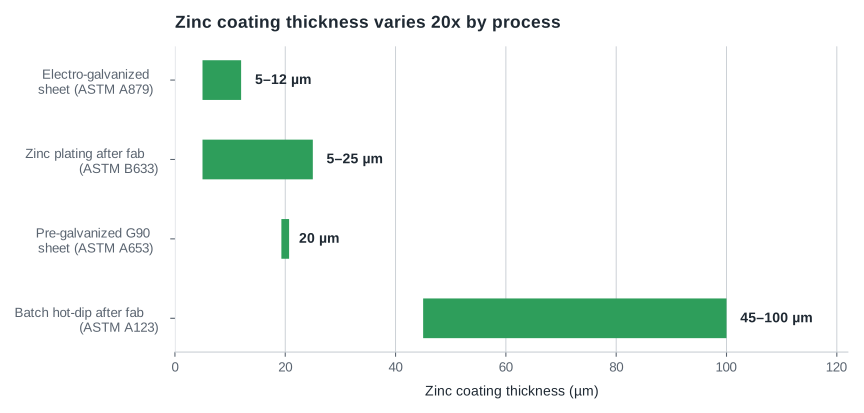
Following figures from the American Galvanizers Association, G90 pre-galvanized sheet gives 0.77 mil per side, against a minimum 1.8 mil for the thinnest batch hot-dip category. That is more than double, and it is why "stainless steel vs hot dipped galvanized" and "stainless steel vs zinc plated" are different questions with different answers.
Which Is Stronger: Galvanized Steel or Stainless Steel?
It depends on the grade. On the grades most people actually order, the popular answer is wrong.
Compare what is stocked for sheet metal work rather than the textbook grades. SGCC galvanized (JIS G3302) has a minimum yield of 200 MPa. SS304 has a minimum yield of 205 MPa. On yield, the point where your bracket takes a permanent set and stops being the part you drew, they are within five megapascals of each other. That is a tie, not a win.
| Grade | Min. Yield | Min. Tensile |
|---|---|---|
| SGCC galvanized | 200 MPa | 380 MPa |
| SS304 / SS316 stainless | 205 MPa | 520 MPa |
| SPCC cold-rolled | 210 MPa | 350 MPa |
| SAPH440 | 305 MPa | 440 MPa |
| Q355 hot-rolled structural | 355 MPa | 490–675 MPa |
| 65Mn spring steel | 785 MPa | 980 MPa |
Those are the figures for our China facility. Our Mexico facility specifies SS316 higher, at ≥290 MPa yield and ≥580 MPa tensile, so if you are ordering from Juárez, 316 genuinely does out-yield galvanized.
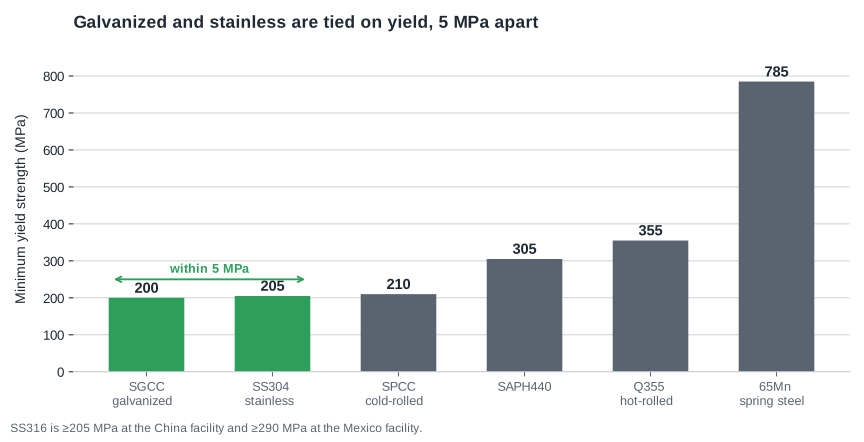
Stainless pulls ahead on ultimate tensile strength, 520 MPa against 380, and on ductility. Annealed 304 carries 40% minimum elongation according to Atlas Steels' grade data sheet, and it work-hardens as it deforms. Deep-drawn shells, formed sinks, anything that has to stretch a long way before it tears. That is 304 all day.
But look at the rest of that table. If the part is genuinely strength-limited, neither galvanized nor stainless is the answer. Q355 hot-rolled yields at 355 MPa and SAPH440 at 305, both well past either. Structural galvanized exists too — ASTM A653 runs from Grade 33 at 228 MPa to Grade 80 at 550 MPa, but those are deliberate specifications, and commercial SGCC coil will not deliver them just because it is galvanized.
Stiffness is a separate question again. Stainless has an elastic modulus around 193 GPa and carbon steel around 200 GPa. That difference is negligible, so swapping materials will not stop a panel oil-canning. Add a rib or a return flange instead.
Which is the real answer here. Strength is a grade decision, not a galvanized-versus-stainless decision. Specifying 304 for strength means specifying a corrosion property and hoping a mechanical one arrives with it.
How Does Corrosion Resistance Compare in Practice?
Corrosion Resistance with Galvanized Steel
Unlike the passive layer on stainless steel, zinc is a consumable. It gradually wears away.
The thicker the coating, the longer it lasts, which is why the AGA recommends at least 3.0 mil for parts kept outdoors or in soil contact. A G90 sheet at 0.77 mil carries roughly a quarter of the zinc the AGA considers adequate for exterior service.
Cut edges are the question engineers ask most, and the answer is better than expected. The Galvanizers Association puts full sacrificial protection at up to roughly 5 mm of exposed steel, which covers essentially every laser-cut edge, pierced hole and tapped thread in 0.5–3 mm sheet. It is a distance limit rather than a rate. A galvanized bracket cut from G90 coil needs no edge sealing, while a 12 mm plate edge does, because the exposed face is simply wider than zinc can reach across.
There is a second reason cut edges hold up better than people assume. Carbon steel up to 6 mm is cut with nitrogen by default at Komacut, and with nitrogen the zinc burn-back at an SGCC cut edge is negligible. The coating is not being cooked back from the edge the way an oxygen cut would.
Zinc does have hard limits:
- pH. According to AGA water-performance data, zinc corrosion is slowest between roughly pH 5.5 and 12, and climbs sharply below pH 4 or above 12.5. Detergents, concrete slurry and acidic process fluids all fall outside that window.
- Temperature. The continuous-service ceiling is 200°C (392°F). Above 250°C the zinc-iron alloy layers crack and separate from the steel.
- Continuous chloride wetting. Splash zones and immersion strip zinc quickly.
Corrosion Resistance with Stainless Steel
Chlorides break down the passive film at a specific point rather than across the whole surface, so stainless gives you pitting and crevice corrosion instead of general thinning.
A 304 part has a pitting resistance equivalent number around 18–20. With 316 it is 23–28, because of its 2–3% molybdenum. That gap is the whole reason marine hardware gets specified in 316.
For coastal environments, pool areas or anywhere de-icing salt is used, 304 is a worse buy than galvanized steel with a powder coat. You pay the stainless premium and still get visible pitting, on a bare surface where it shows.
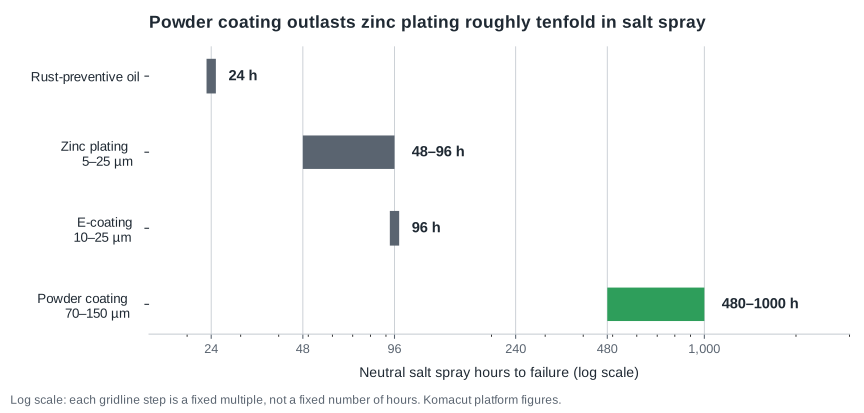
The coating numbers make the case. Measured by neutral salt spray, zinc plating carries a part 48–96 hours and e-coating 96 hours, while powder coating runs 480–1,000 hours at 70–150 µm of film. That is roughly a tenfold difference between the thin zinc most people picture when they hear "galvanized" and a properly powder-coated carbon steel part. Pretreatment before powder coating is part of the standard process, not an extra, and it is what that adhesion and corrosion performance depends on.
So either step up to 316, or put a powder coat on carbon steel. Picking bare 304 as the middle option is the one choice that satisfies neither requirement.
Crevices are the other trap. Stainless needs oxygen to repassivate. Under a gasket, inside a lap joint, or beneath a washer that traps moisture, it can corrode faster than a galvanized part in the same spot, because zinc does not depend on oxygen to do its job.
Galvanized vs Stainless Steel Cost
304 costs more per kilogram than galvanized carbon steel, and the multiple does not hold still. Nickel drives it. MEPS International tracked LME Class 1 nickel from a low of $14,110/t in December 2025 to a peak of $18,725/t on 29 January 2026, then up 14.5% to $19,270/t across three weeks in April, driven by Indonesian ore quota cuts and sulphur supply disruption. The International Nickel Study Group is forecasting a 32,200-tonne supply deficit for 2026, the first since 2021. If you priced a stainless part six months ago, reprice it.
Galvanized carbon steel has none of that exposure. Its cost tracks scrap and hot-rolled coil, which move for entirely different reasons.
Material is only part of the picture, and the production side is where the received wisdom about these two materials falls apart.
Cutting: Less of a Difference Than You Have Been Told
The standard story goes like this: stainless has to be cut with nitrogen, mild and galvanized steel get cut with oxygen, oxygen is faster and cheaper, so stainless costs more to cut.
That is not what our production data shows.
At Komacut, carbon steel up to and including 6 mm is cut with nitrogen by default. Above 6 mm it switches to oxygen. Stainless and aluminium run on nitrogen throughout. So for sheet metal work, which is nearly all of it under 6 mm, galvanized and stainless are cut with the same assist gas.
Nor is nitrogen the expensive option. On our own figures the theoretical cost per cutting minute for oxygen versus nitrogen works out at 100.59%, meaning oxygen is fractionally more expensive per minute, not less. And nitrogen is faster: at 6 mm, nitrogen cuts at 7 m/min against oxygen's 3.4 m/min.
Where oxygen does earn its place is thicker plate, which is why we switch above 6 mm. But at the gauges this comparison actually covers, cutting is not where the cost difference between galvanized and stainless comes from. One caveat worth keeping: oxygen leaves a chromium-oxide layer on a stainless cut face that degrades corrosion resistance and will not hold paint, which is why stainless stays on nitrogen at every thickness.
Bending: This Is Where Stainless Actually Costs You
Austenitic stainless work-hardens as it deforms, and that shows up in three places on the press brake.
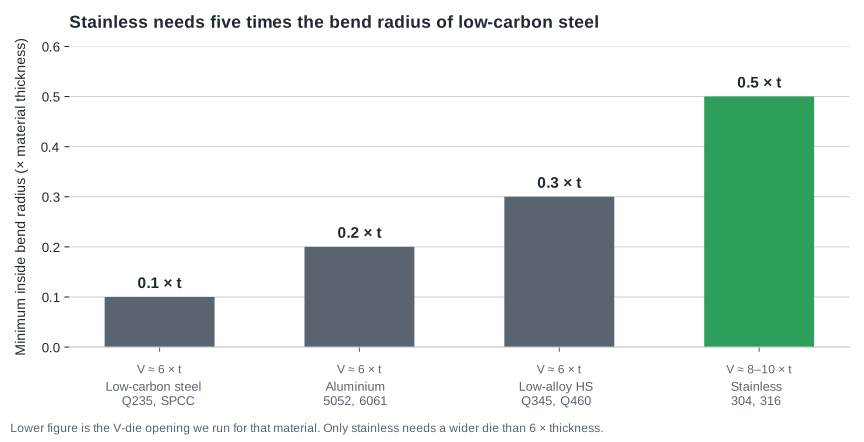
It needs a wider die opening. Our bending standard puts 2 mm carbon steel on a V12 die and 2 mm stainless on a V16. At 6 mm it is V40 against V60. Carbon steel runs at roughly 6 times material thickness; stainless needs about 8 times, widening towards 10 times as the plate gets thicker.
It needs a larger bend radius, and this is the one that catches people out at design stage. Our standard puts low-carbon steel (Q235, SPCC) at a minimum bend radius of 0.1 × thickness, and austenitic stainless (304, 316) at 0.5 × thickness. Five times the radius. If you have drawn a tight bend in stainless, check it before you order, because the geometry may not be manufacturable at the radius you want.
And it springs back more. We will not quote you a single number for it, because there is not an honest one. Springback varies with material batch, thickness, local impurities, die selection and the bend angle itself. Anyone publishing one figure for stainless springback is guessing. For reference, our carbon steel standard reserves around 2° of springback compensation at 3–6 mm, and stainless runs higher than that.
Multi-bend parts compound all three, since each bend work-hardens the material for the next one. Our CNC sheet metal bending page covers the geometry limits.
Handling and Finishing
At Komacut, materials are kept segregated throughout the production chain — this is not specific to stainless. Press brake tooling is maintained on a schedule and there is a cleaning standard before use, which is what prevents free iron from carbon steel transferring onto a stainless surface and rusting weeks later on a part that was specified stainless precisely so it would not.
Protective film is more conditional than most people assume. Parts needing a brushed finish, passivation or a specific cosmetic appearance are filmed to prevent scratches and pressure marks during forming. Internal reinforcement parts with no appearance requirement are generally run without it, for cost and throughput. If the surface finish matters on your part, say so on the drawing.
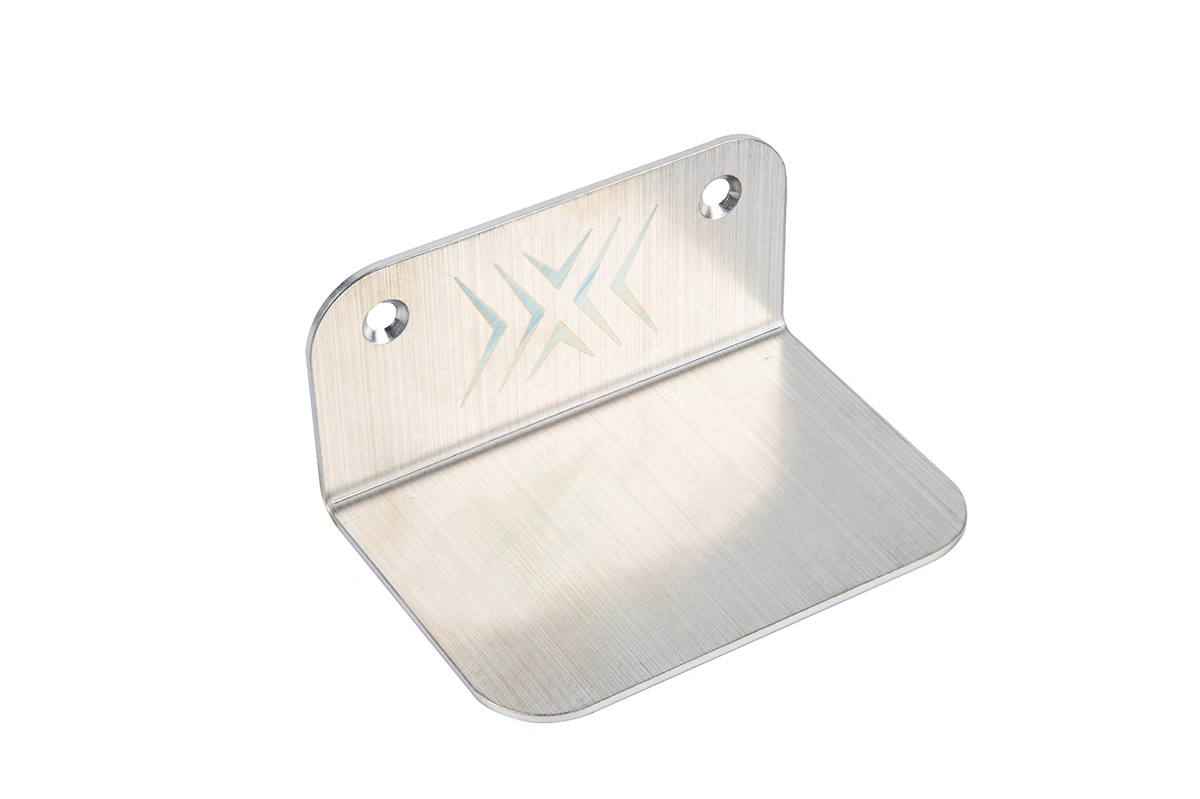
Deburring runs by default on both materials, so that is not a differentiator. What does differentiate them: cosmetic stainless usually needs graining or passivation on top. Passivation removes free iron from the surface and leaves a thin transparent oxide film of 0.5–15 µm, and it is stainless-only.
Long-Term Durability
The life-cycle argument for stainless is real, but it only pays when replacement is expensive. A welded-in structural member behind a wall: spend the money. A bolt-on bracket you can swap in ten minutes: the upfront cost is the cost.
Zinc Plated Steel: Matching the Coating to the Environment
Another way to add corrosion resistance is to zinc plate a steel part after fabrication. For cut-and-formed parts this is often the right answer, because it covers everything the sheet coating cannot — edges, holes, threads and bend radii.
ASTM B633 sets thickness minimums across four service classes:
| Class | Min. Thickness | Environment |
|---|---|---|
| SC1 | 5 µm | Dry indoor, no condensation |
| SC2 | 8 µm | Indoor with humidity or occasional condensation |
| SC3 | 13 µm | Outdoor, general weather exposure |
| SC4 | 25 µm | Road salt, coastal air, industrial chemicals |
Compare that to pre-galvanized coil: G30 gives 6.6 µm per side, G60 gives 13 µm, G90 gives about 20 µm. A G90 sheet part carries more zinc than an SC3 plated part on its faces, and none at all on its cut edges, where it relies on throwing power instead.
That is the trade. Pre-galvanized is cheaper and thicker on flat faces, so it wins on large, mostly-flat parts where edges are a small fraction of the surface area. Plating after fabrication covers everything, so it wins on small parts with a lot of cut perimeter.
One practical point before you specify a service class. Komacut plates trivalent blue zinc at 5–25 µm, which spans the full B633 range, up to a 1,200 × 400 × 400 mm envelope — but that range is what the platform offers, not a menu of selectable classes. If your part needs a specific coating thickness at the SC4 end, that is a conversation with our team rather than a dropdown. Flag it with your order.
Also be mindful of which finishes go on which materials. Zinc plating is carbon steel only. Passivation is stainless only. The finish you need narrows your material choice as much as the other way around.
Electro Galvanized vs Stainless Steel
Electro-galvanized is a thin coating at 5–12 µm. Its job is to protect parts that stay indoors and dry, or to act as a substrate for paint or powder. At the low end of that range it carries less zinc than B633's mildest indoor class, so bare outdoor service is not a real option.
Against stainless it competes on price alone, and only for indoor parts. If the part is getting powder-coated anyway, EG sheet is usually the cheapest defensible choice, and stainless is money spent on a surface nobody will ever see.
When to Specify Galvanized or Stainless Steel
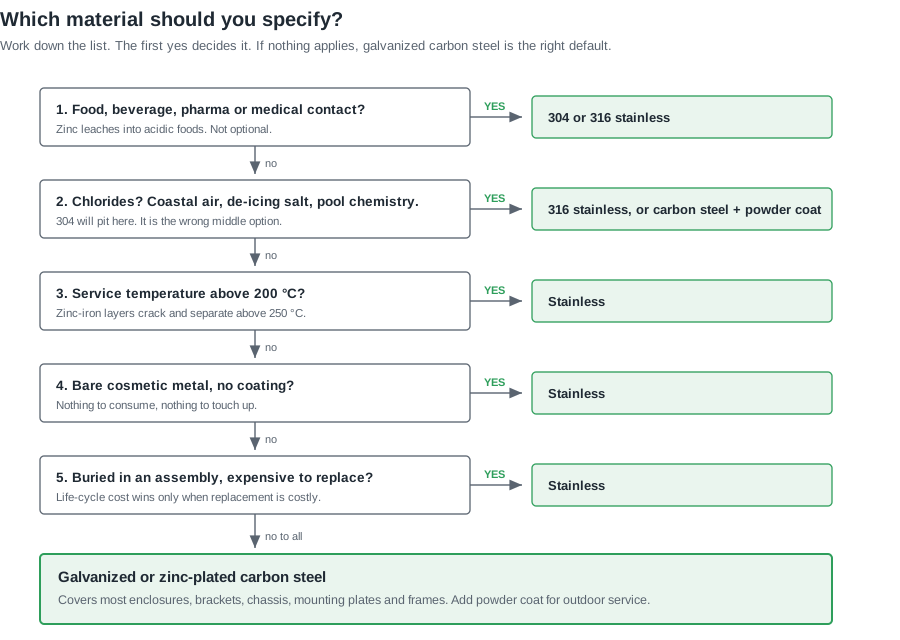
Specify galvanized or zinc-plated carbon steel for parts that stay indoors or sheltered, anything that gets painted or powder-coated, structural sheet components where yield strength matters, and any part accessible enough to replace quickly. That covers the majority of enclosures, brackets, chassis, mounting plates and frames.
Specify 304 stainless for food, beverage, pharmaceutical and medical applications; wash-down environments; bare cosmetic metal; service temperatures above 200°C; and parts buried far enough into an assembly that replacing one means tearing down several others.
Specify 316 stainless wherever chlorides are in the picture: coastal installations, de-icing salt, pools, chemical processing. It costs more up front, but 304 will pit in those environments and need replacing sooner.
The Fastener Rule for Mixing Stainless and Galvanized Steel
Bolt a stainless fastener into a galvanized panel and you are fine. Bolt a zinc-plated fastener into a stainless panel and it will fail.
That looks backwards until you consider area ratio. As the AGA analysis explains, a zinc rivet in a stainless plate is a tiny anode against a large cathode, so it corrodes rapidly. A stainless rivet in a zinc plate reverses the ratio. Attack spreads shallowly over a wide anode, penetration depth stays low, and the fastener survives.
The ASSDA rule of thumb is to keep the anode's wetted area at least ten times the cathode's.
None of this matters in dry indoor air, where there is no electrolyte to complete the circuit. It matters a great deal in wash-down, coastal and immersed service, where isolating washers or bushings become part of the design rather than an afterthought.
Three Final Considerations Before Uploading Your File
Will Your Galvanized Part Be Welded?
Welding a galvanized part boils off the zinc and releases zinc oxide fume. The OSHA permissible exposure limit is 5 mg/m³ over an eight-hour shift, and ACGIH sets a tighter 2 mg/m³ TLV. Beyond the ventilation requirement, welding destroys the coating in the heat-affected zone, so you are back to bare steel exactly where the joint is.
For outdoor welded assemblies, galvanize after welding to ASTM A123 rather than welding pre-galvanized sheet. That is a batch process on a finished weldment, which puts it outside what an on-demand parts platform does. Komaspec handles welded and assembled products where this comes up.
Are You Designing a Part for Food Contact?
Then it needs to be stainless. Zinc leaches into acidic foods and galvanized steel is not approved for direct food contact, so it is simply not an option here.
Check the Finish Envelope, Not Just the Material
Coating processes have size limits that the material does not, and they bite sooner than people expect:
- Zinc plating: 1,200 × 400 × 400 mm
- Passivation: 900 × 800 × 400 mm
- Powder coating: 2,400 × 1,800 × 1,200 mm
Sheet sizes run larger than all of those. Galvanized (SGCC) coil goes to 1,250 × 2,500 mm and stainless to 1,220 × 2,440 mm. Laser cutting handles up to 20 mm thick and bending up to 10 mm and 600 mm wide.
So a part can clear the sheet size and the bend limits and still be too big for the finish you wanted. Check the finish envelope before you commit.
On tolerances: our standard laser cutting linear tolerance is ±0.45 mm, or ±0.20 mm on high-precision parts, with hole diameters at ±0.12 mm and ±0.08 mm respectively. Material thickness tolerance is banded separately by thickness, from ±0.05 mm on 0.5–2.0 mm sheet out to ±0.50 mm on 10–20 mm plate. Full figures are on our process tolerances page.
Instant DFM Checking
Try Komacut's instant quotation tool
Get fast, accurate cost estimates that factor in material and fabrication tolerances, so you can plan, budget, and refine your sheet metal parts with confidence.
Frequently Asked Questions
Is galvanized the same as stainless steel?
No. Galvanized steel is carbon steel with a zinc coating applied to the surface, and that zinc is consumed over time. Stainless steel is an alloy containing at least 10.5% chromium throughout its thickness, forming a passive oxide film that regenerates when scratched. One is a coating with a service life; the other is a permanent material property.
Which is stronger, galvanized steel or stainless steel?
It depends on the grade. On the grades we stock, SGCC galvanized has a 200 MPa minimum yield and SS304 has 205 MPa, effectively a tie. Stainless wins clearly on tensile strength, 520 against 380 MPa, and on ductility. If you need yield strength, specify Q355 or SAPH440 rather than either.
Is galvanized or stainless steel better?
Neither is universally better. Galvanized suits indoor, sheltered or painted parts where cost matters and the part is replaceable. Stainless is required for food contact, wash-down environments, service above 200°C, and bare cosmetic surfaces. For chloride exposure such as coastal air, de-icing salt or pool chemistry, specify 316 rather than 304.
Can you use stainless steel fasteners with galvanized steel?
Yes, and that is the correct direction. The small stainless fastener acts as the cathode against a large galvanized anode, so corrosion spreads shallowly across the panel and the fastener survives. The reverse pairing, a zinc-plated fastener in a stainless panel, concentrates attack on the fastener and causes rapid failure.
What's the difference between electro-galvanized and hot-dipped galvanized?
Coating thickness and how the zinc is applied. Electro-galvanizing deposits 5–12 µm electrolytically, giving a smooth surface suited to painting and indoor use. Hot-dip galvanizing immerses steel in molten zinc, producing about 20 µm on continuous-line sheet and up to 100 µm on batch-galvanized parts, with far longer outdoor life.
Is galvanized steel safe for food contact?
No. Zinc leaches from the coating on contact with acidic or high-moisture foods, and galvanized steel is not approved for direct food contact. Use 304 or 316 stainless for any food, beverage or pharmaceutical contact surface. Galvanized remains acceptable for structural or non-contact components in those facilities.
Pick the coating before you pick the material. If the part lives indoors, gets painted, or bolts on where you can reach it, galvanized or zinc-plated carbon steel will do the job for less money, and in the structural grades the extra yield strength comes free. Save stainless for the cases that genuinely demand it.
Upload your STEP file to Komacut and price the same part three ways: SGCC galvanized, SPCC with zinc plating, and SUS304. Instant quote in about 30 seconds, with DFM feedback on the bends before you commit.