
304 vs 316 vs 316L Stainless Steel: Differences and How to Choose
- Key Takeaways
- 304 vs 316 Stainless Steel
- When 304 Stainless Steel Is the Wrong Choice
- 316 vs 316L: Does the Difference Matter?
- What About Strength and Fabrication?
- The Cost Difference Between 304 and 316 Stainless Steel
- How to Choose the Right Stainless Steel Grade
- Frequently Asked Questions
The 316 stainless steel vs 304 question comes down to one element: molybdenum. 316 contains 2–3% molybdenum and 304 contains none, which makes 316 far better at resisting chlorides (salt spray, road salt, brines, pool chemicals) and roughly 20–40% more expensive. For indoor parts and general fabrication, 304 is the right choice. Once chlorides enter the picture, move to 316. And if the part will be welded, specify 316L, the low-carbon version that keeps its corrosion resistance intact around the weld.
That's the short answer:
- 304 Stainless Steel: Parts or products meant for indoor use.
- 316 Stainless Steel: Parts or products that may be exposed to chlorides.
- 316L Stainless Steel: Parts or products that will be welded.
The rest of this guide goes deeper into explaining why these are usually the right choices, the cost of each grade, and how they factor into sheet metal fabrication.
Key Takeaways
316 has a 2-3% molybdenum content and 304 has none - and that's what makes 316's performance stand out when it comes to resisting chlorides, and it comes at a cost of 20-40% more than 304.
You can use 304 for parts that are going to be indoors, whereas 316 is your go-to when something's going to be out in the elements (think marine environments, places with lots of road salt, or chemical processing facilities). Then there's 316L for when a part's going to be welded.
When it comes to annealed 304 and 316, they've got the same minimum strength specs under ASTM A240 - so don't worry about that when choosing between the two. What you do need to think about is the corrosion exposure you're dealing with.
One more thing to consider when choosing between 316 and 316L is weld decay - because in 316L you can only have up to 0.03% carbon whereas 304 allows 0.08%. That slight difference in carbon is actually a game-changer for 316L when it comes to preventing weld decay and while it does come at the cost of a slightly lower minimum yield strength (170 MPa vs 205 MPa).
Table of Contents
- 304 vs 316 Stainless Steel: What's the Difference?
- When 304 Stainless Steel Is the Wrong Choice
- 316 vs 316L: Does the Difference Matter?
- What About Strength and Fabrication?
- The Cost Difference Between 304 and 316 Stainless Steel
- How to Choose the Right Stainless Steel Grade
- Frequently Asked Questions
304 vs 316 Stainless Steel: What's the Difference?
304 and 316 are both austenitic stainless steels from the 300 series, meaning they're chromium-nickel alloys. Looking at them side by side, you couldn't tell them apart. But at the elemental level, there are some important differences:
304 vs 316 vs 316L: Elemental Composition
| Element | 304 | 316 | 316L |
|---|---|---|---|
| Chromium | 18–20% | 16–18% | 16–18% |
| Nickel | 8–10.5% | 10–14% | 10–14% |
| Molybdenum | — | 2–3% | 2–3% |
| Carbon (max) | 0.08% | 0.08% | 0.03% |
Each of those elements has a job and affects the properties of the material:
- Chromium forms the passive chromium-oxide film that makes the material stainless. The film repairs itself when it gets scratched (as long as there's oxygen present).
- Nickel stabilizes the austenitic structure, which gives the material its ductility and weldability.
- Molybdenum reinforces the passive chromium-oxide film against localized chloride attack.
304 is often called 18/8 stainless because of the elements present (18% chromium, 8% nickel). It is the most widely produced stainless grade in the world. You'll encounter it everywhere from kitchen equipment to enclosures and tanks.
With 316, the main difference is the presence of molybdenum. This helps it resist corrosion, making it preferable for applications where there may be exposure to chlorides.
When 304 Stainless Steel Is the Wrong Choice
Chloride is a big deal for stainless steel because it attacks the passive film that protects the material. Worse, it attacks locally. Instead of spreading over the entire surface, the chloride will break through the film in one spot. The corrosion will localize on that spot and tunnel into the material, creating the kind of pitting corrosion you've likely seen on old tanks left outdoors.
Another risk is crevice corrosion. It works the same way, but in tight gaps, like under fastener heads or behind gaskets. Crevice corrosion is insidious, because the stainless steel might look clean while the pitting is happening out of sight.
This is why you'll see a lot of corrosion in environments with heavy chloride exposure:
- Marine and coastal areas, where seawater and salty air can cause 304 stainless steel to start pitting within a matter of months. This applies to inland structures that are near the coast, since salt air carries inland and chlorides can accumulate over time.
- Roadside equipment and structures, due to the de-icing salt used to keep roads and walkways safe.
- Food processing operations where brines are in heavy use, like pickling, cheesemaking, and meat processing (but 304 grade is fine for most general food prep).
- Chemical and pharmaceutical processing, especially when chlorinated cleaning agents and process chemicals are used.
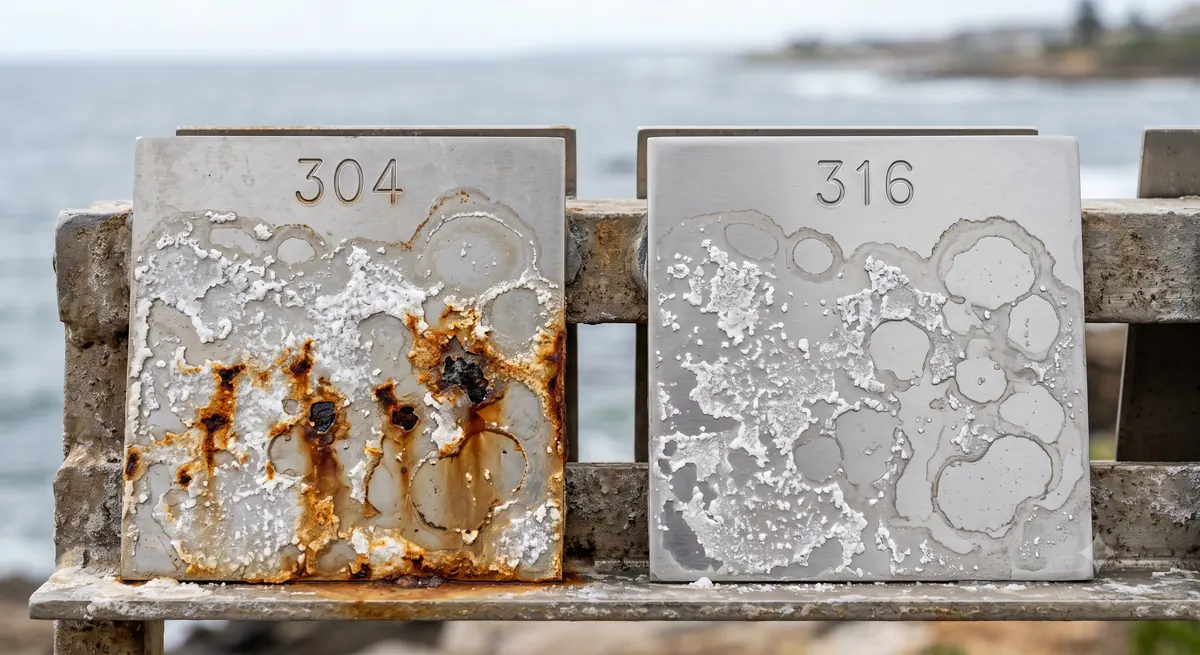
In any of those environments, you should opt for 316 grade. It comes with a higher up-front cost, but it saves you from dealing with corrosion.
In most other places, 304 will hold up just fine. Even rain and humidity shouldn't be a problem, especially with a powder coat or a proper passivation treatment after fabrication. Paying a premium to use 316 stainless steel to build an indoor electronics enclosure is simply a waste of money when 304 would work just as well at a lower cost.
316 vs 316L: Does the Difference Matter?
Let's say you've determined that you need 316 stainless steel. Should you stick with 316 or go for 316L instead?
The L stands for "low carbon." This means the material contains a maximum of 0.03% carbon (compared to 0.08% for standard 316).
For welded parts, those carbon levels make all the difference.
That's because of something called "sensitization." When austenitic stainless steel (including 316) is heated between 425–815°C, carbon migrates to the grain boundaries and binds with chromium, forming chromium carbides. This process starves those boundaries of the chromium they need to maintain their passive protective film.
The result: corrosion along the grain boundaries, near the weld.
Welders call this weld decay, and it defeats the purpose of paying extra for 316 in the first place.
For these applications, you'll need 316L. With less than half the carbon, it doesn't form enough carbides to compromise the protective film.
If you're working with standard 316, you can avoid sensitization with a post-weld solution anneal. But that involves heating the finished assembly above 1,000°C and quenching it, which is impractical for most sheet metal work.
So if the part will be welded and used in a corrosive environment, 316L is the right option. The strength penalty is small (ASTM A240 minimum yield drops from 205 to 170 MPa) and much of the flat-rolled stainless steel on the market is dual-certified 316/316L anyway, so it meets the low carbon limit of 316L and the strength minimums of 316 at the same time.
What About Strength and Fabrication?
Strength doesn't factor into this decision. Per ASTM A240, annealed 304 and 316 stainless steel have identical strength minimums: 515 MPa tensile, 205 MPa yield, 40% elongation.
Some people pick 316 because they think it's stronger than 304. But that's simply not the case.
What is different, however, is fabrication behavior. It's close, but not identical:
- Laser Cutting: Both grades cut cleanly on fiber laser. 316 does cut slower because of its higher alloy content, but for typical sheet gauges the difference won't show up in your part price.
- Machining and Tapping: Both work-harden, but it's slightly worse with 316. Threaded holes in 316 cost a bit more tool life, which is one of the reasons 316 parts are quoted higher than they would be if the cost were based on raw material alone.
- Finishing: Passivation after fabrication removes free iron picked up from tooling and restores the passive layer. It's cheap insurance on any stainless part and worth specifying on 316 parts headed for the environments you bought 316 for.
Bending: Both grades form well on a CNC press brake with the same tooling. You do have to watch out for springback, since this is a bigger problem with austenitic stainless than it is with cold-rolled steel. But either grade has the same issue.
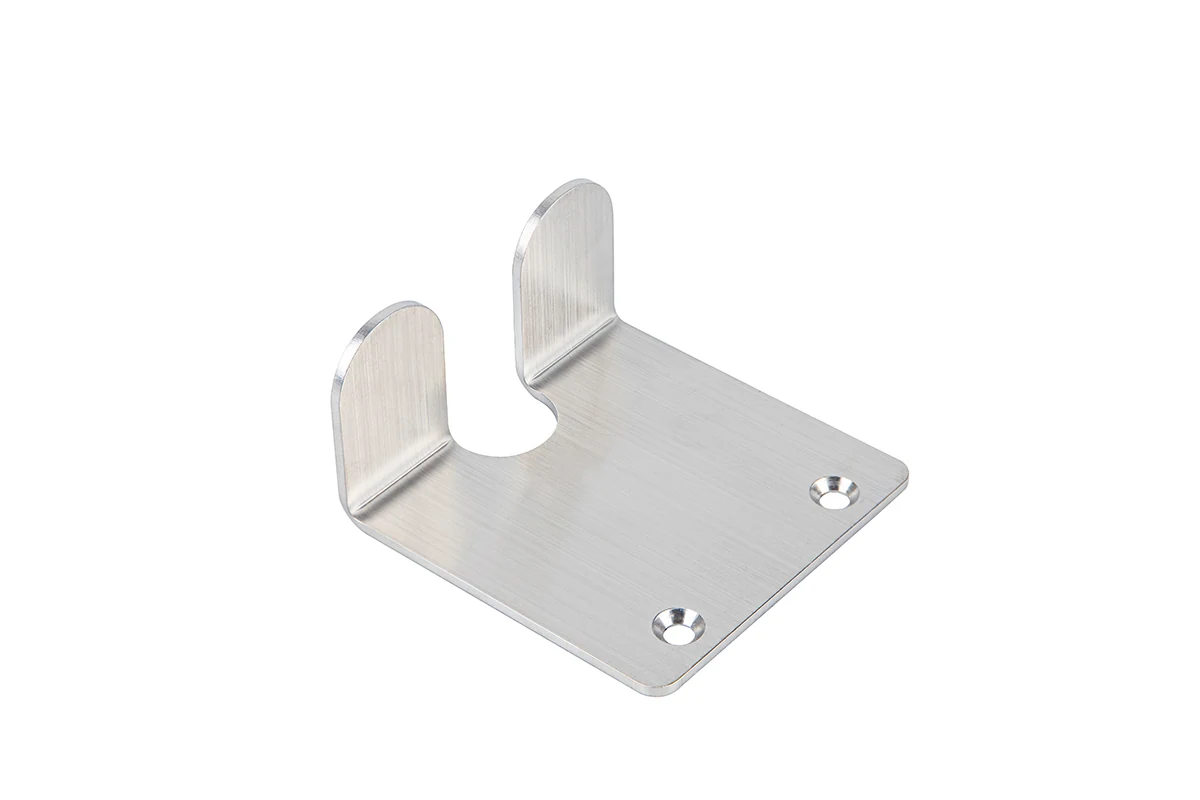
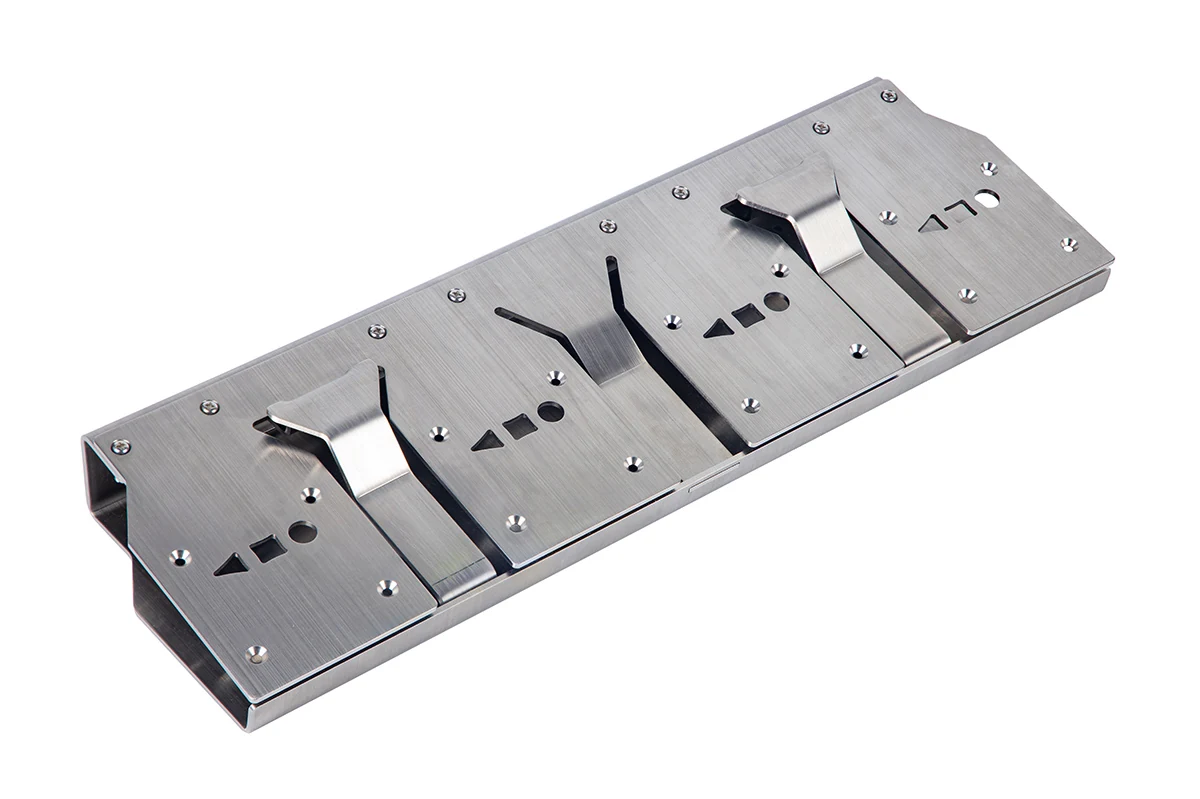
When you're ordering sheet metal, the grades are interchangeable in every respect except chemistry and price. Komacut stocks SS304, SS316, and SS316L at both its China and Mexico facilities, so the grade choice doesn't affect lead time.
The Cost Difference Between 304 and 316 Stainless Steel
316 grade raw materials will run you about 20 to 40% higher than comparable materials in 304 grade. This is mostly due to the extra nickel content and the molybdenum, both of which trade as commodities.
With fabricated parts, the price gap is smaller. That's because cutting, bending, and finishing costs are the same regardless of the grade used, so the material costs get diluted by everything else that factors into the unit price.
If your materials are destined for an environment with corrosion risks, the added cost for 316 grade is well worth it. Building a coastal junction box with a 316 enclosure will save you the trouble of making a service call, replacing the pitted parts, and dealing with a frustrated customer.
When there is chloride in the environment, 316 is the cheap option.
How to Choose the Right Stainless Steel Grade
304 vs 316 vs 316L: Selection at a Glance
| Application | Grade |
|---|---|
| Indoor enclosures, brackets, chassis | 304 |
| Food equipment without brines or heavy salt | 304 |
| Inland outdoor, powder coated or passivated | 304 |
| Food processing with salts, brines, acids | 316L |
| Marine, coastal, or salt-air exposure | 316 (316L if welded) |
| Roadside equipment near de-icing salt | 316 (316L if welded) |
| Chemical or pharmaceutical processing | 316L |
If this table doesn't settle it, ask yourself two questions.
- Will the part be exposed to chlorides (salt, brine, seawater, chlorinated cleaners)? If not, use 304 and save on the cost.
- If there is a risk of chloride exposure, will the material be welded? If so, go with 316L. Otherwise, you can stick to 316 or dual-certified 316/316L, whichever your supplier stocks.
Instant DFM Checking
Try Komacut's instant quotation tool
Upload your CAD file to Komacut and quote the same design in SS304, SS316, and SS316L to get pricing and DFM feedback in about 30 seconds.
Frequently Asked Questions
Is 316 stainless steel stronger than 304?
No. When annealed, both grades have the exact same ASTM A240 minimums: 515 MPa tensile and 205 MPa yield strength. Don't base your decision on strength. Instead, base it on whether the material will be used in a corrosive environment (if so, go with 316).
Are 304 and 316 stainless steel magnetic?
Neither grade is magnetic when annealed, since both are austenitic. Cold working during bending or forming can induce slight magnetism in the material, especially in 304. But holding a magnet to the part is not a reliable way to distinguish between the two grades.
Is 304 stainless steel considered food grade?
Yes. 304 is the most common food-grade stainless steel. It's used in sinks, tanks, and prep equipment. 316 is preferred where food preparation involves heavy use of salt, brines, or acidic solutions, since these can cause pitting corrosion in 304 grade stainless steel.
Can you visually tell 304 stainless steel from 316?
No. The two grades look identical. The only reliable way to distinguish them is documentation, meaning a mill test certificate traceable to the batch, or positive material identification (PMI) testing with an XRF analyzer. If you're not sure of the grade and the difference matters, request the certificate.
What is marine-grade stainless steel?
Marine-grade stainless steel is grade 316. It contains 2–3% molybdenum, which protects against pitting and crevice corrosion caused by exposure to seawater and salt air. 304 grade stainless steel will pit and stain in coastal environments, which is why 316 is the minimum standard for marine hardware.