
- Key Takeaways
- How Does Anodizing Work?
- Type I, Type II, Type III: What's the Difference?
- Which Aluminum Alloys Anodize Well?
- How Much Does Anodizing Change Part Dimensions?
- Black Anodized Aluminum: What to Know Before You Spec It
- Anodizing vs Powder Coating for Sheet Metal
- When Should You Use Anodized Aluminum?
- When You Shouldn't Anodize
- FAQ
Anodized aluminum is a type of aluminum whose surface has been converted into aluminum oxide. The oxide isn't added to the surface, like paint or plating would be. Instead, as the Aluminum Anodizers Council (AAC) explains, it grows out of the metal itself when the part is placed in an acid bath and a current is passed through it. That's why an anodized surface can be scratched but can't chip, flake, or peel.
Use anodizing when an aluminum part needs corrosion and wear resistance without added thickness, and still has to look like metal. A standard Type II film runs 1.8–25.4 µm according to the AAC, thin enough that it changes a hole diameter by only about 0.015 mm. Use powder coating instead when the color has to match a specification, when you need more than a few hundred hours of salt spray life, or when the part isn't aluminum.
Anodizing aluminum gives it corrosion resistance, the ability to be dyed, an electrically insulating skin, and a much harder surface. That third one is easy to overlook, and it's the property that causes trouble on parts that have to carry a ground.
Key Takeaways
Anodizing grows a layer of aluminum oxide out of the base metal itself, so the finish resists corrosion, changes the part's appearance, and can't chip, flake, or peel.
The color and appearance of anodized aluminum depends on the specific alloy of the base metal.
Black anodized aluminum can look excellent, but the color fades under prolonged UV exposure unless the film is thick enough and the dye is rated for it.
5052-H32 with a clear or black Type II anodize is a suitable option for most sheet metal parts.
A 15 µm Type II film grows a part by about 0.015 mm and shrinks a hole by the same amount, which is a rounding error against standard laser-cut tolerances.
Aluminum oxide is a dielectric. Anodizing insulates every mating face, so mask the contact zones or design in a bare pad on any part that carries a ground.
Table of Contents
- Key Takeaways
- How Does Anodizing Work?
- Type I, Type II, and Type III Anodized Aluminum: What's the Difference?
- Which Aluminum Alloys Anodize Well?
- How Much Does Anodizing Change a Part's Dimensions?
- Black Anodized Aluminum: What to Know Before Specifying It
- Anodizing vs. Powder Coating for Sheet Metal
- When Should You Use Anodized Aluminum?
- When You Shouldn't Anodize
- Frequently Asked Questions
How Does Anodizing Work?
Anodizing is a five-step process that runs in a specific order:
- Clean the aluminum. An alkaline soak strips oils, cutting fluid, and fingerprints from the surface.
- Etch or brighten the material. Caustic etch gives the aluminum a matte surface, while a phosphoric-nitric bright dip will give it a specular one. This step determines what the material's surface will look like.
- Anodize the part. The part goes into a sulfuric acid bath and acts as the anode. Per the AAC, the standard decorative conditions are a 15% sulfuric solution at 20 °C and 12 amps per square foot, run for 10 to 60 minutes.
- Dye the metal using organic dye or metal salts. The oxide is porous while it's still fresh, so the dye draws into the pores.
- Seal the part using hot water or a nickel acetate bath. This hydrates the oxide and closes the pores, which locks in the dye and protects the part from corrosion.
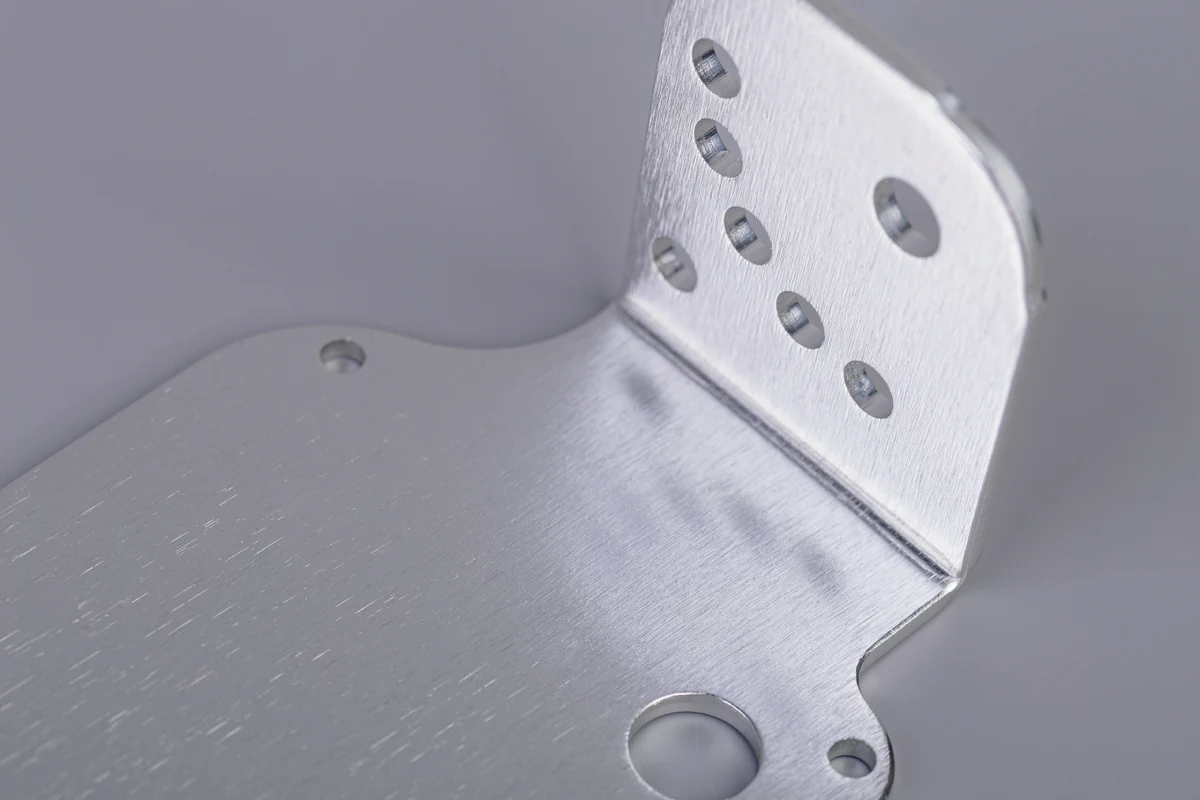
The thickness of the resulting film is mainly based on how much time the part spends in the tank. Ten minutes yields a film roughly 2.5 µm thick, while an hour grows it to 18 µm or more. The color depth, color stability, and salt spray life of the part all depend on the thickness of that protective layer.
Type I, Type II, and Type III Anodized Aluminum: What's the Difference?
Most anodizing callouts are based on MIL-A-8625. It covers six types and two classes, but there are three that matter most in practice:
MIL-A-8625 Anodizing Types at a Glance
| Type | Electrolyte | Thickness | Typical use |
|---|---|---|---|
| Type I / IB | Chromic acid | 0.5–7.6 µm | Fatigue-sensitive aerospace parts, paint pre-treatment |
| Type II | Sulfuric acid | 1.8–25.4 µm | General corrosion protection, decorative and dyed finishes |
| Type III | Sulfuric acid, near-freezing bath | 12.7–115 µm | Wear surfaces, hardcoat |
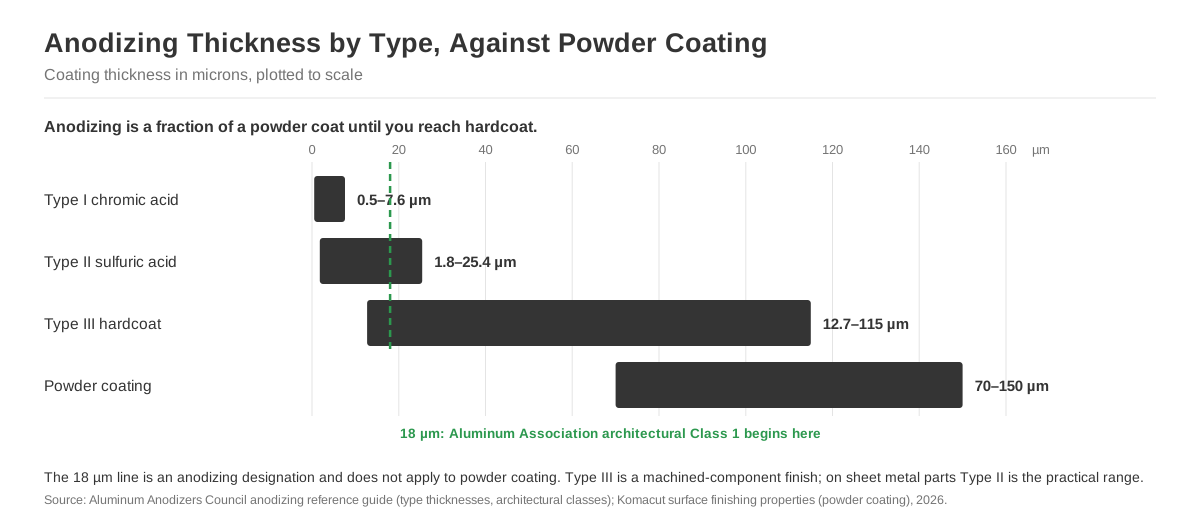
The thickness ranges in this table are derived from the AAC. Types IC and IIB are non-chromate substitutes for the chromic acid coatings, introduced as environmental restrictions on chromium tightened.
Class 1 vs. Class 2
Class 1 simply covers undyed aluminum, while Class 2 is for dyed aluminum. That's it.
But here's where it gets tricky. The Aluminum Association's architectural designations also use Class 1 and Class 2 for anodized aluminum, but these designations refer to thickness, not whether the part has been dyed. Architectural Class 2 is 10–18 µm, while Architectural Class 1 is 18 µm and above, and exterior architectural service is where that thicker film is expected.
So if a drawing says "Class 1 anodize" but there is no spec number listed with it, ask which system the designer meant to avoid any mistakes or confusion.
Type II vs. Type III
For sheet metal parts, Type II is the only one worth discussing.
Type III is a machined-component finish that runs at bath temperatures near 0 °C at high current density. It takes hours to complete and costs several times more. It can be worth it if you're building a hydraulic valve block, because it could keep it from galling. But there's no real benefit to specifying Type III on a 2 mm bracket, so make sure it's worth the expense first.
And as Products Finishing points out, there is no standard hardness for Type III coatings. So if you specify hardcoat for your part, it won't necessarily give you the hardness number you need. That number depends on the alloy and the anodizing conditions. Products Finishing reports 350–360 HV on a 7075-T6 part that was wearing through in service, and notes that a Rockwell C hardness of 50 to 60 (roughly 520–700 HV) is achievable under certain combinations of process and alloy, without tying that figure to a specific grade. ISO 10074 sets a minimum of 400 HV for Class 1 wrought alloys, which is a more useful thing to put on a drawing than figures listed in a vendor's marketing materials.
Which Aluminum Alloys Anodize Well?
The alloying element in your part will determine the color of the film. The AAC's alloy reference breaks this down by series:
Aluminum Alloy Series and Anodized Appearance
| Series | Main alloying element | Anodized appearance |
|---|---|---|
| 1xxx | None (99%+ pure) | Clear and bright, but soft and prone to etch staining |
| 2xxx | Copper | Yellow, but poor weather protection |
| 3xxx | Manganese | Grayish-brown, but hard to match sheet to sheet |
| 4xxx | Silicon | Dark gray, heavy smut |
| 5xxx | Magnesium | Clear, with good protection |
| 6xxx | Magnesium + silicon | Clear, with good protection |
| 7xxx | Zinc | Clear, but above 5% zinc the film picks up a brown tint |
The AAC also classifies certain alloys as being of "anodizing quality," which includes 5005, 5657, 6063, and 6463. Two grades that are stocked as standard for sheet metal work, 5052 and 6061, don't show up on that list, yet they anodize perfectly well. But they don't make the cut simply because they aren't controlled for cosmetic consistency, meaning the color of the metal can drift between batches.
Here's a practical rundown for the aluminum grades stocked for sheet metal work:
- 5052-H32 forms well, offers reliable protection, and forms a clear film when anodized. Default to this grade unless there's a good reason not to.
- 6061-T6 also anodizes cleanly, but it is harder to form. It's fine for parts that stay flat or are only lightly formed, but it will cause trouble for designs with more pronounced bends.
- 6063-T5 is an anodizing quality grade of aluminum, which ensures cosmetic consistency.
- 7075-T6 can be anodized, but expect to see a bronze cast on clear finishes.
- 1060 is bright but soft, so racking and handling can leave visible marks on its surface.
If you mix different alloys in a single anodized assembly, they're unlikely to match. If one bracket is made from 5052 and another from 6061, expect them to look different, even if they were processed in the same tank. So make sure to use the same alloy for visible parts that need to have the same appearance.
How Much Does Anodizing Change a Part's Dimensions?
Anodizing grows a film on the material's surface, but also consumes some of the metal at the same time. The AAC puts it at a 50-50 ratio, where the depth of the film's penetration into the metal is roughly equal to the surface build-up. In other words, half the film sits below where the original surface was, and half of it sits above that line. Metal Finishings Ltd translates this in practical terms, stating that the part's external dimensions will grow by half the film thickness per surface, while the internal diameters will shrink by roughly the full thickness of the film (because both walls of the hole grow inward at once).
So on aluminum sheet with 15 µm of Type II film (typical for a dyed black finish), you'd have:
- Build-up per surface: 7.5 µm
- Growth on an outside dimension: 0.015 mm
- Reduction in a hole diameter: 0.015 mm
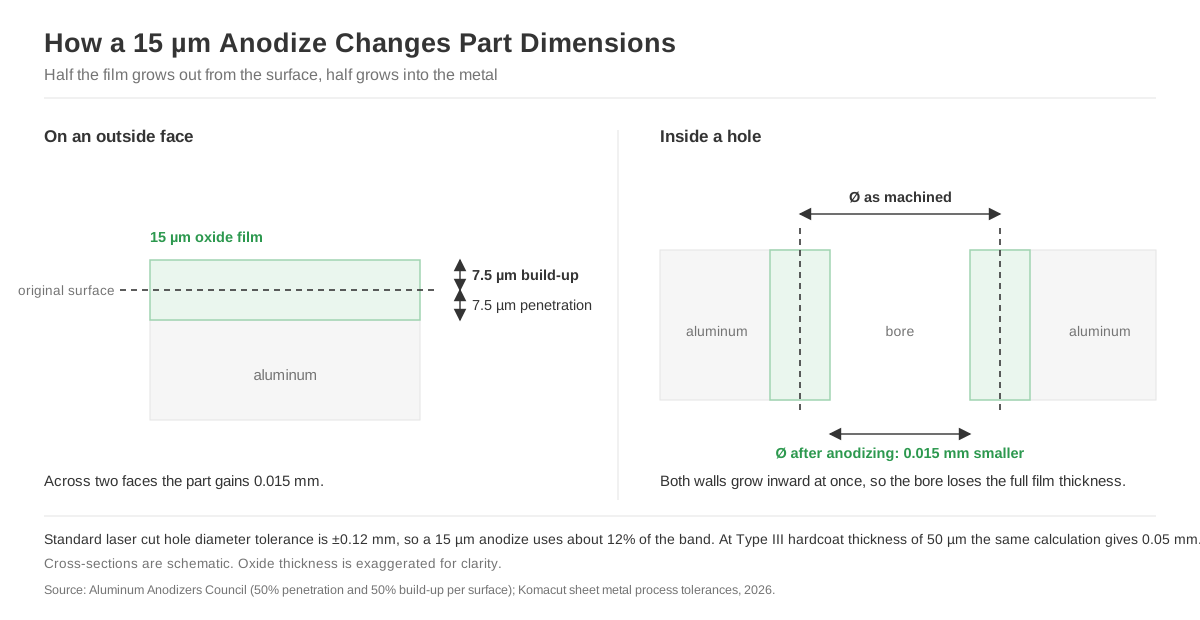
Now compare that to the standard laser cutting tolerances, which are ±0.45 mm linear and ±0.12 mm on hole diameter. Anodizing takes about 12% of the hole tolerance band. And even on high-precision cutting with a ±0.08 mm tolerance, it's still under 20%.
So for Type II sheet metal parts, anodic growth is not a real problem. It's a rounding error compared to the tolerance you're already working with. Design the clearance holes normally and don't worry about how much the anodizing process will change them.
Hardcoat thickness is another story, though. A 50 µm Type III film adds 25 µm on each surface, so a bore loses 0.05 mm. That's enough to close down an H7 fit or bind a bearing seat. You can compensate for this by masking, pre-machining oversize, or chasing threads after finishing. Proceed carefully here: Type III on a precision bore without a dimensional allowance is one of the more expensive mistakes in aluminum finishing.
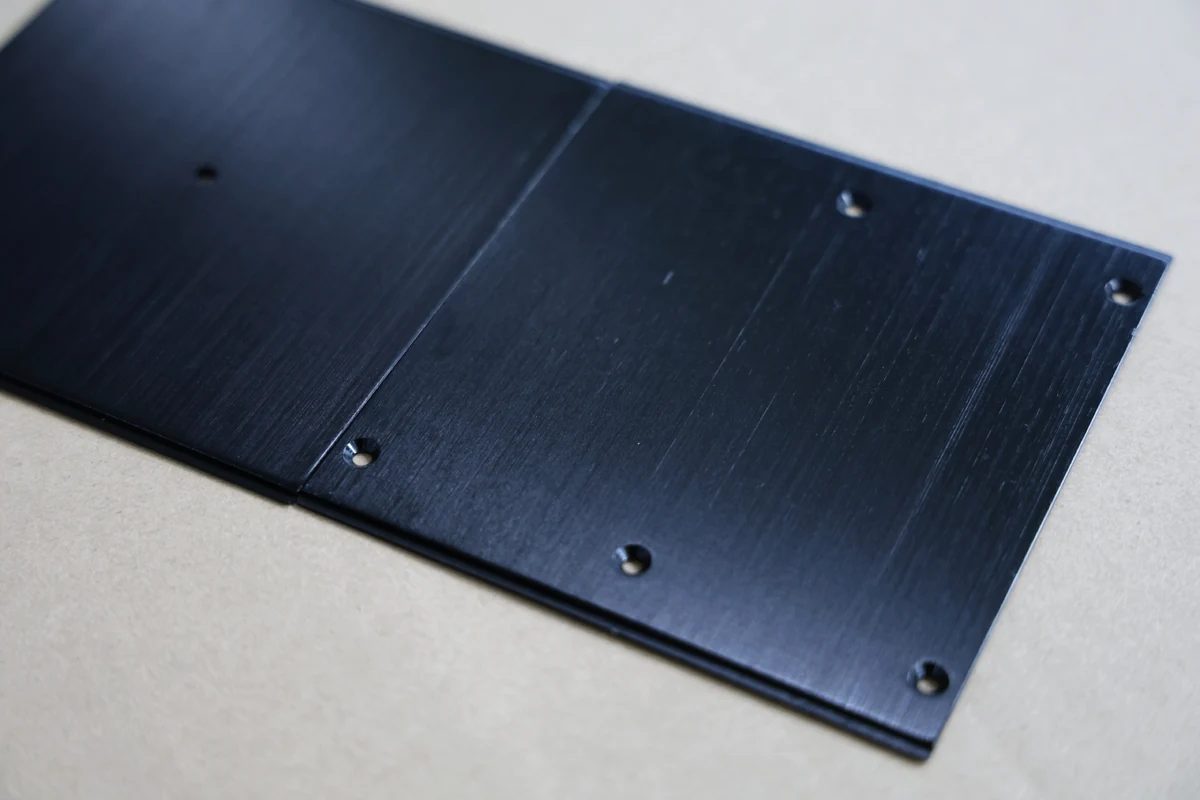
Black Anodized Aluminum: What to Know Before Specifying It
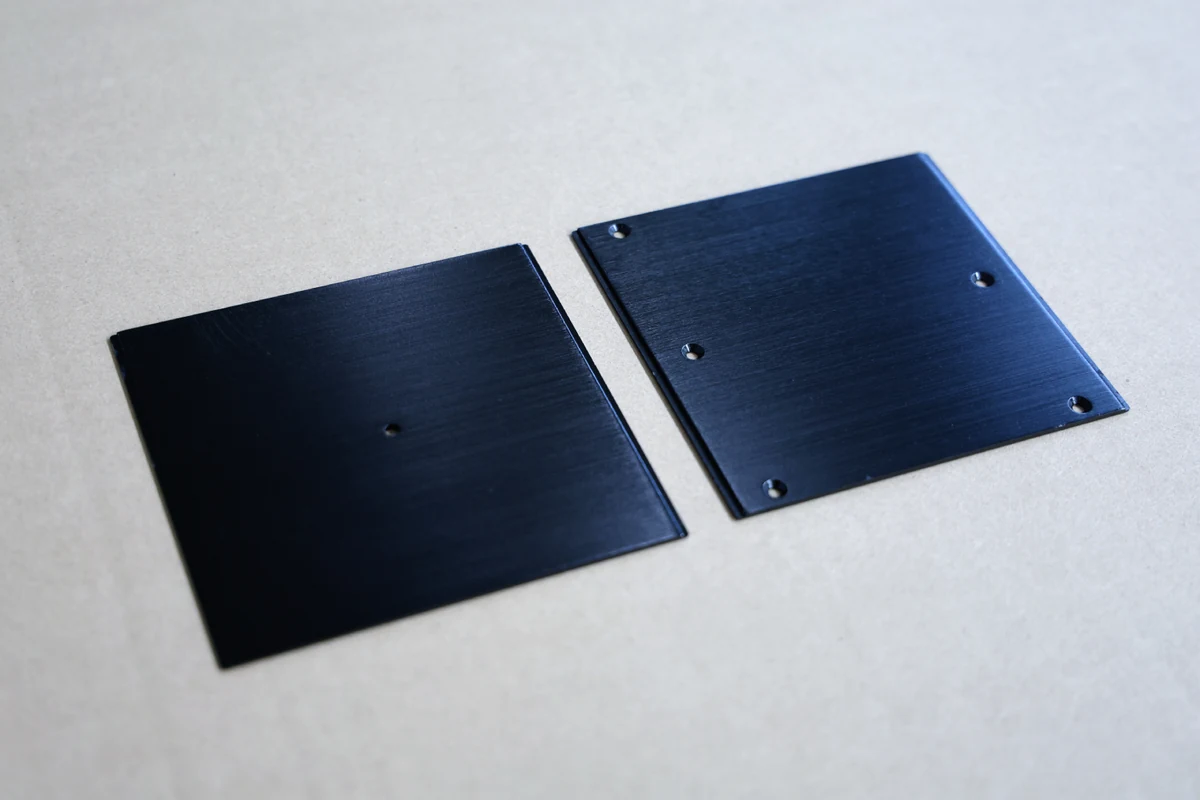
Black is a popular choice for anodized aluminum, and it's also the one most likely to disappoint.
The dye lives in the pores of the oxide. A thin film has less pore volume, which means it holds less dye and produces a weaker shade of black that fades easily. It looks fine when it leaves the factory, but it soon turns brown when it's put in service.
For a deep, lightfast black, you need about 15–18 µm of oxide and up to 20 minutes of dye immersion, according to Products Finishing.
UV is another factor. Organic black dyes break down under sunlight and even fluorescent lighting. And black anodize doesn't just lighten when it fades, but it actually takes on a bronze or purple coloring. ISO 2135 rates the lightfastness of dyes from 1 to 8, and only dyes rated 8 should be used for parts that will be used outdoors. Even then, Products Finishing notes that the dye could still fade under real operating conditions, and that the quality of the anodizing and sealing could be part of the reason.
The alternative to organic dyes is metal salts driven into the pores electrolytically. This produces coloring that is far more UV-stable. But the palette is limited, which is why you see bronze and black as architectural colors, but not bright blue.
The upshot here is, if your part is meant to sit in direct sun for years, the color won't hold if you dye it in. Use powder coating instead.
Anodizing vs. Powder Coating for Sheet Metal
These two processes are often treated as interchangeable, but they're not. One look at the surface finishing properties table makes that obvious:
Anodizing vs. Powder Coating for Sheet Metal
| Property | Anodizing | Powder coating |
|---|---|---|
| Materials | Aluminum only | Aluminum, carbon steel, stainless steel |
| Coating thickness | 1.8–25.4 µm (Type II) | 70–150 µm |
| Salt spray | 336 h is the MIL-A-8625 requirement | 480–1,000 h |
| Colors | Natural and black | Full RAL and Pantone range, gloss, and texture |
| Failure mode | Scratches through to bare metal | Chips, and corrosion creeps under the edge |
| Max part size (sheet metal) | 1500 × 1000 × 400 mm | 2400 × 1800 × 1200 mm |
| Appearance | Surface still looks like metal | Metal looks painted |
In this table, the salt spray value for anodized aluminum is a threshold set by the specification. It does not reflect the anodizing layer's actual service life. Treat this value as a minimum rather than a rating.
Powder coating beats anodizing for corrosion resistance, color options, and maximum size. It's also your only option for parts that aren't made of aluminum.
Anodizing has three advantages over powder coating: it essentially adds no thickness so it doesn't affect fits and threaded holes, it can't chip so it doesn't give corrosion a starting point, and the aluminum keeps its metallic appearance (which is often desirable for consumer-facing hardware).
Ultimately, if you need to achieve a specific color or match the appearance of the housing, go with powder coating. But if the finish is meant to protect the part or have it look like machined metal, anodizing is the right choice.
When Should You Use Anodized Aluminum?
Anodize an aluminum part when it needs corrosion or wear resistance, has to hold its dimensions, and should still look like metal. It's the wrong call when color is a specification or the part isn't aluminum. Here are four cases where anodizing makes sense.
The part gets wet or salty. The oxide is chemically stable in the conditions that pit bare aluminum, which is why anodizing is a standard callout for marine and saltwater service. Komacut's finishing reference lists it as a common choice for exactly that.
Something rubs against it. Think hinges, slides, and panels that get handled every day. The oxide is harder than the aluminum beneath it, so it absorbs the handling wear that would scuff bare or painted metal. For genuine metal-on-metal sliding, though, you're in Type III territory rather than Type II.
Fit matters more than color. A 15 µm film moves a hole by 0.015 mm against a ±0.12 mm tolerance. Nothing needs re-tapping, no clearance holes need opening up, and threaded features come back usable. A 70–150 µm powder coat has to be designed around from the start.
The aluminum should still look like aluminum. At a few microns thick, the finish leaves brushed grain and machining texture visible, while paint and powder bury both. If the part lives outdoors permanently, push the thickness up: the Aluminum Association's architectural Class 1 starts at 18 µm.
When You Shouldn't Anodize
Avoid anodized aluminum in any of the following situations.
The part carries a ground path or needs EMI continuity. Aluminum oxide is a dielectric. So let's say you decide to anodize a chassis. In doing so, you're inadvertently insulating every fastener boss, earth stud, and mating surface on the part. The right move here is to either mask the contact zones or design a bare pad into the part. But make sure to confirm masking capability with your supplier before releasing the drawing, because only some finishing lines offer it. Otherwise the part looks perfect and then fails a ground bond check at assembly, which is a late and expensive place to find out.
Your part is used in a welded assembly. The chemistry of the filler alloy will show through the anodized layer. For instance, ESAB notes that 4043 will take on a dark gray color after anodizing, so it should never be used for applications that requires a matching appearance. If you're aiming for a consistent look, use 5356 instead. This is a problem you can't fix just by grinding the weld flush before anodizing it (and doing that would also weaken the joint). If you have a welded anodized aluminum assembly that needs a uniform appearance, it's worth scoping the job with an engineering team from the start. Komaspec handles welded and turnkey assembly work of this kind.
You're working with an alloy that does not anodize well. Copper-bearing 2xxx aluminum alloys can be anodized, but the result is a yellow film that doesn't provide much protection. High-silicon casting alloys can also be anodized, but will give a dark gray appearance. If you chose the material for its strength but selected the finish to achieve a certain look, you'll need to go back on one of those decisions to get the right outcome.
The color needs to be consistent across batches. The color of the anodized surface depends on the specific alloy, temper, mill lot, surface prep, and bath chemistry. This means that two ostensibly identical production runs done six months apart can come back with different cosmetic results. If your parts need to match visually, they should be anodized in the same batch. If that's not possible, finish them with a coating instead.
Instant Finish Pricing
Try Komacut's instant quotation tool
Upload your STEP file and compare anodized natural, anodized black, and powder coating side by side in about 30 seconds — with size limits flagged automatically for the finish you pick.
Frequently Asked Questions
Does anodized aluminum rust?
No, because it doesn't contain any iron. Anodized surfaces can corrode under salty or alkaline conditions. But anodizing thickens the natural oxide barrier on the surface of the metal, which slows down that process. MIL-A-8625 requires sealed coatings to survive 336 hours of exposure to neutral salt spray without undergoing meaningful pitting corrosion.
Can you paint over anodized aluminum?
Yes. The porous oxide layer on the surface of anodized aluminum is a good base for paint. In fact, Type I anodizing exists largely as a pre-treatment for painted surfaces. Once the surface is sealed, however, it becomes less porous and primer won't adhere to it as well. For better results, only paint anodized surfaces that are unsealed (or only lightly sealed).
Does anodized aluminum wear off?
The anodized layer is part of the metal itself, so it can't flake or peel off. But it can be scratched or worn through. Type II film is typically around 5–25 µm thick and resists handling, but it can scratch from contact with other metal surfaces. Corners also tend to wear first, because the oxide is more brittle at sharp edges and the aluminum underneath it is soft.
Can any aluminum alloy be anodized?
Technically yes, but they won't all result in a cosmetically appealing surface. 5xxx and 6xxx alloys give clear films with good protection, but copper-bearing 2xxx alloys have a yellow coloring and give poor weather resistance, and high-silicon 4xxx alloys and castings turn dark gray when anodized. Check the alloy to confirm you'll get the desired finish.
Does anodizing add thickness to a part?
It does. Specifically, it adds thickness equal to about half the thickness of the film. That's because the other half of the thickness actually grows into the metal. So 15 µm Type II coating will add roughly 0.0075 mm per face and will close holes by about 0.015 mm. For most applications, that amount of extra thickness doesn't make a practical difference. But if you're using Type III hardcoat, the film will have a thickness of 50 µm or more, and that might require you to adjust the design to accommodate it.